Sunday, October 4, 2009

A conservative health care plan

I'd be very interested to hear what any conservative American proposes to do about health care. The starting place is to acknowledge the problem.

We have a terrible infant mortality rate -- 6.3 per 1000 per year, over twice as high as the leading nations (Scandinavian countries, Singapore, Japan, Hong Kong). We're ranked somewhere below places like Slovenia, Portugal and -- yes -- Cuba. Check this out at any site you like; Wikipedia includes the list from the CIA World Factbook, which says we rank 46th in the world, just ahead of Belarus, Lithuania and Cyprus. (http://en.wikipedia.org/wiki/List_of_countries_by_infant_mortality_rate)

Do the conservatives disagree with this? No.

We have the highest health care bills in the world. (1) Many people don't have insurance to cover the cost of early tests and preventative care, so the ultimate costs of care are higher than they should be. (2) The overhead costs are way too high, due to the administrative costs of HMOs and other insurers, and because of an antiquated tort system which has driven the premiums for malpractice insurance through the roof.

Do the conservatives disagree with this? No.

Some of us (me included) have outstanding care -- I'm covered by Blue Cross / Blue Shield at a relatively modest cost, because my employer is fairly generous. I've never been turned down by my insurer for any test ever requested by my physician.

But I have friends who pay over $10,000 per year in insurance premiums -- healthy, retired people with no previous conditions. And we all know someone who has been denied a necessary treatment because of cost.

Do the conservatives disagree with this? No.

Inadequate support for preventative medicine and early treatment end up costing us billions. It's not clear how quickly those costs would drop under the president's plan. But over the long run, they're going to destroy us financially, unless we do something.

Do the conservatives disagree with this? No.

So, tell me, what did the conservatives propose after defeating Clinton's plan? Nothing. What do they propose now? Nothing. Why? Because they're frightened by the insurance companies and the pharmaceutical companies, who are spending millions to defeat a plan that will cost them profits -- profits that are part of our high health cost.

Many countries have successful systems that mix private options with public options. So do we - Medicare and Medicaid. It's funny how those who keep screaming that Obama wants to destroy your options aren't screaming about how we should eliminate the "socialist" Medicare and Medicaid programs. Those programs have been the only thing between many elderly people and poverty.

Do the conservatives disagree with this? No.

I don't know the solution to the health care problem. But an honest discussion of options would seem a logical thing for us to engage in. With regard to a public option that would force the insurance companies and drug manufacturers to compete -- isn't that one of the Republicans favorite words? It seems to me something that deserves serious consideration at the least.

I ask again, one last time, what do conservatives propose to do?

Sunday, May 31, 2009

Piety

How did a religion that began with a focus on kindness, service and gentleness -- unselfishness -- become so preoccupied with the most selfish of all actions: saving one's own soul and getting into heaven?

Requiem aeternam dona eis, Domine,
et lux perpetua luceat eis!
Cum sanctis tuis in aeternum,
quia pius es.

Give them eternal rest, Lord,
and shine eternal light upon them!
With thy saints forever,
for Thou art good.

quia pius es -- for thou art good.

pius  =  dutiful, conscientious; godly, holy; good, upright  (Collins Latin Dictionary).

pious  =  devoutly religious; making a hypocritical display of virtue; dutiful or loyal [archaic]  (New Oxford American Dictionary).

----------------------

It was, of course, Christ's own church that corrupted his message. By the Middle Ages, the Holy Roman Catholic Church was telling its members that, if they didn't follow the church's dictates, they would burn in hell. They were damned by original sin, and the path to heaven lay through the Church:  prayer, ritual, and giving one's assets to the Church, rather than by service to one's fellow beings and giving directly to the poor. The Church accumulated land, gold and power. The poor and powerless sank into ignorance and misery, comforted with the promise of eternal life with all God's saints, if and only if the Church interceded with Him for them.

Then, flickers of light with Gutenberg and Luther. Literacy, the right to read God's word oneself, the right to pray directly to Him without earthly or saintly intermediaries. Renaissance.  Enlightenment. Intelligence seen as a gift from God, rather than a tool of Satan.

Progress, the end of slavery, the right of people to rule themselves -- eventually all people, regardless of race, religion, gender, or sexual orientation.

And today?  What a wonderful and terrible world!  There are lots of people who are pious in the original way -- dutiful, good, kind, generous, loving. And there are a lot whose piety is no more than a hypocritical display of virtue. Churches that serve God by serving the poorest and weakest among us, and churches that serve only the powerful, and themselves.

If only all Christians would stop worrying about saving their own butts and getting into heaven ... and simply strive to be pius.

Thursday, May 28, 2009

summer is a-cummin

End of the semester.  The only people happier than the students are the faculty.

I should face a string of days with plenty of time for writing.  I've got to make major progress on The Book, a couple of manuscripts need polishing and submitting, and I've got a couple of review articles to write.

But the first month is already gone -- finals were over and grades posted by the end of April, and the new students arrive before labor day -- and I've gotten far too little writing done. A week-long trip to the west coast was interesting (UCLA, Sandia Labs and a NASA meeting in Phoenix) and offered some fun (time with old Peace Corps friends in Albuquerque), but it added to the backlog of stuff on my desk, out from under which I'm just emerging.

To complicate matters, May has been mostly beautiful, when it wasn't raining.  I sit at our new big table in the recently closed in back porch / sunroom, listening to birds calling across the neighborhood and hearing music from downstairs, where Marie is working in her studio. I'm thinking that it's time to open the bar...


Monday, April 6, 2009

How does (the other) one...?

After a long weekend with a friend -- a good friend -- visiting us from out of town, I wonder how (the other) one tells one that one has a habit that is irritating.  A habit that might need changing...

In this case, the habit is talking on and on about stuff that might be interesting if there were an exchange of ideas, but that becomes increasingly tedious as one rambles on and on.

One talks about oneself, and (the other) one wonders, is one is interested at all in (the other) one?

Will there ever be a break in which (the other) one can interject something?  And if there is, will one actually care?

Will one ever ask a question that hints, however vaguely, at some passing interest in (the other) one?

Will one ever ask a question which, when (the other) one gives an answer, will actually be of interest to one, rather than just an excuse for one to move on to the next monologue about one's self?

Should (the other) one just wedge one's way into the conversation, pushing one aside and telling a story of (the other) one's own experience that compares to one's?  Is conversation just to be a shoving match?

Or should (the other) one express (the other) one's concern to one?  And, if so, how?

Should (the other) one take one aside later and tactfully suggest that one sometimes dominates the conversation a bit much?  that others, even others other than (the other) one, have become a bit bored, perhaps?

If (the other) one does this, what is the probability that one would appreciate being made aware of this?

Should (the other) one be really blunt and ask one to shut the fuck up once in a while?

Well, one went back home, and life is back to normal for (the other) one...

Saturday, March 28, 2009

Philly and Ann Arbor

A long weekend (last weekend), a couple of days in Philadelphia with Ian and Mandy, followed by a couple in Ann Arbor with Sarah.

It is such a delight to see our kids doing so well, and so excited about their lives. Ian's a good man -- doing well at a job that he'd prefer not to do, to provide support for the two of them. He was always a reliable, hard worker once he committed to a job. He's thinking hard about what he wants to do next, and where he'd like to go in the long run. He's gotten inspired about the possibility of historical restoration, which would combine his love of history with an artistic profession (architecture). Mandy's working her tail off at University of the Arts, loving every exhausting minute. Well, almost every one. And Sarah's thriving at the University of Michigan.

We arrived in Philly on the day that the student show went up -- Mandy's first exhibition at UA. She was done with the printing, but not with all the stitching that goes into her piece. It's a sweet graphic tale, and very nicely done to these non-expert eyes. But she got pretty badly beaten up at the critique the next day. She had to leave the room and go to her studio space for a good cry, and when Marie, Ian and I got to their apartment after our day at Penn's Landing, she was sound asleep, making up for the very long days she'd been working. It was really good that Marie could be there to provide her with some perspective on the process.

Even I tried to contribute something. I told her how we beat our graduate students up at their written and oral exams, particularly when they're defending their thesis proposals. It's painful, but an essential part of developing both a sharp set of self-critical skills, and a thick skin. Any creative person -- artist or scientist -- is putting himself out there in a very vulnerable place, and it can be pretty painful sometimes. You're so invested in what you've done -- your vision -- and your ego is on the line, too, in terms of the technical skills you have brought to the task of executing the work that shows your vision.

One big ego issue is intelligence. Although the intelligences of the artist and the scientist have different forms, we're all bright, or we wouldn't be in the art game or the science game. And many of us have had a lifetime of strokes from parents, teachers and peers, telling us how bright we are. So it's really painful when we fall short in others' eyes.

Sometimes rejection comes from people we know but don't really have a lot of respect for. That still hurts, because we know that there are others who do respect their opinions.  Sometimes rejection comes from people we don't know very well. That hurts even more, because we don't know enough about them to easily dismiss their criticisms. But what really hurts is when we get rejected by someone whose opinion we do value. After such occasions, how many times have I asked myself "Why do I do this to myself???"

Ian and Marie and I had a day of tourism together while Mandy was preparing for, and then enduring, the critique of her work. We started our morning with the Seaport Museum, which was pretty cool. But the best parts were lunch, and visiting two warships after lunch.

Lunch was at the City Tavern, a reproduction of the Inn where the founding fathers often ate and drank. Waiters in knee britches, etc. I expected it to be tacky and touristy, but since it was a slow day, it was actually really nice. I'd commented on the bus headed toward the waterfront that I hoped for sauerkraut and sausages for lunch. By coincidence, the chef at the City Tavern is German, and there were some great sausages and great sauerkraut. With a pint of I-forget-which of the colonial brews, I was one happy camper!

Then to the ships...

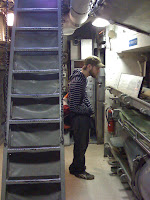
I really like museums that feature art, or history, or anything military, or stuff related to engineering/industrial prowess. So I'm a real sucker for warships that you can walk through, because they give three out of four. We visited two of those at Penn's Landing: the Olympia, Admiral Dewey's flagship in the Philippines and later one of TR's White Fleet, and the Becuna, a WWII sub. (The latter even included some cartoons and other graphic memoribilia from the men who served on her, so it was a four for four experience...

Fortunately, Ian gets off on this stuff, too. Marie tends to be put off by the ultimate purpose of these beasts, but she humored us and enjoyed the elegantly paneled officers' mess on board the Olympia, at least after her fashion, while Ian and I wandered around the rest of this rather sweet old lady of the sea. Marie did stay topside while Ian and I prowled through the Becuna, however. Between her abhorrence of war and a tendency to claustrophobia, this boat had no appeal for her.

Like most guys who walk through these things, I try to imagine what it must have been like. Forty or more men sharing a single toilet, one minute showers once per week, plus the constant stink of diesel fuel, oil and fumes. Days, weeks, perhaps months of sheer boredom, punctuated by hours of fear and tension, and sometimes of sheer terror. Although I never wanted to serve on a sub (although it did sound really cool!), I was, like most boys of my generation, seduced by the prospect of serving topside. Since I was raised in a time when the draft was still in full force, I always thought I'd have to serve. I was a patriot, even David looked good in dress whites, and the sea beckoned...  I thought that I would become a man the first time I landed a jet plane on the deck of an aircraft carrier. My last semester at Berkeley I took the exams for Navy OCS and passed everything that I needed for flight school. Except my sitting height, which would have precluded my flying one or two of the fighters.

Thank God I changed my mind at the last possible minute and didn't show up for induction in San Francisco in January 1963. I'd made every commitment except actually signing. When the Viet Nam war ended and the prisoners got off the transport planes at Subic Bay, the Navy pilots all looked just like me -- tall, skinny, crew cuts. Hell, I wanted to sail around the Mediterranean and flirt with Italian girls, not drop bombs on people with whom I had no quarrel.

I was a little embarrassed the first time I boarded the Alabama in Mobile, in my late thirties. The first thing I thought was, "Damn! There sure are a lot of guns!!" Then, when we went onto the armor deck, the one beneath 16 inches of steel, I couldn't help wondering what it must have been like down there when hit by a bomb, even one small enough that it didn't penetrate the armor. I say I was embarrassed, because it was as if I'd never really thought about the meaning of the damned ship.

-------------------

Our time with Sarah was very full - we walked all over campus (well, you can't really walk over all the Michigan campus, perhaps in this lifetime), and through much of Ann Arbor. Sarah's dorm, where we met her roommate and some friends, the arboretum (twice), the Union 
(I love Big Ten Unions from the 20's and 30's), the Natural Science Museum, an a capella concert by Amazing Blue, a compelling movie (The Class, based on the true story of the difficulties of an idealistic young teacher in a multiracial / multicultural school in a tough Parisian neighborhood, starring the actual teacher and his students), a great Japanese meal, an OK meal at Black Pearl ("seafood and martinis" should have been a warning)...  She's loving UM and doing really well, but like lots of students today, she is really stressed a lot of the time.

Tuesday, March 17, 2009

Billy, Part 2

Suspicious that there might be a second cat under the house, I reset the trap Sunday morning.

Last night, I climbed into bed beside a sleeping Marie and closed my eyes. I was quickly headed down and out. But I got brought back up by a thump that I thought came from the furnace duct. I sat up and waited.

A moment later I heard a faint meowing, and I knew there was a second cat. I got up, put on pants, shoes and a sweater, grabbed a flashlight and headed for the basement.

When I opened the door from the basement into the crawl space, I found the trap empty, except for the undisturbed cat food bait; the entrance gate was still open. "Shit," I thought, "a smart one." I figured he'd avoided the trap, either because he'd seen the other cat in it, or because he was kept away by the still strong scent of cat piss.

But when I shone the flashlight into the deeper recesses of the crawl space, there he was -- Billy -- looking right at me. I took the light out of his eyes and called to him, and he came right out. He stopped to rub against my legs and chat with me and, once I'd closed the door to the crawl space, he did the "Billy stand": rising up on his back legs to invite my hand to his head, then standing as high as he can to intensify his pleasure. And mine.

I let him out of the basement, but he hung around, waiting for a handout. So I gave him a small bowl of kitty chow. That was probably a bad idea, because he's a well-known mooch throughout this part of the neighborhood, but I was so damned glad to see him clean and sleek and healthy and happy.

Welcome back, Billy!


Monday, March 16, 2009

Qualifying Exams

Minmin and Yingying have just retreated to their respective exam rooms, to begin working on their comprehensive written exams.

We struggle, as a faculty, to come up with the best way of evaluating second-year graduate students as they make the transition into full-fledged researchers. They have to do two things: First, they must demonstrate a sufficiently broad and deep knowledge of the material they need to know to do research on their chosen problem. Second, they have to write and defend an intelligent research proposal, showing that they are familiar with the state of knowledge in their field, that they can identify an important problem, and that they can choose a logical approach to solving that problem; there must also be sufficient preliminary data to convince us that they can carry out the proposed research.

The real problem is the first part -- what, exactly, is "a sufficiently broad and deep knowledge of the material they need to know"? My students need to have strong backgrounds in biology and/or chemistry and/or physics and/or biochemistry and/or biophysics and/or computer programming and/or mathematics and/or ...  Hell, they need to know everything I know, and everything I should know but don't!

The really hard part is testing the ability to think. The written qualifier isn't supposed to be a regurgitation, although it almost always contains huge doses of that. It's supposed to demonstrate the student's ability to apply what he/she knows to new problems. But it's really hard to design questions that test that.

--------------

I remember my own written comprehensive exam. It ranged from overly simple to delightfully tough.

The overly simple part was a mechanics question that shouldn't have bothered an undergraduate: a bowling ball is launched with velocity v0 and without rolling, so it slides along the floor; after a while it is rolling without sliding. If there were no loss of kinetic energy due to friction, what would the final velocity be?

The delightful question was: Suppose the electron had spin 3/2. Discuss. (b) Suppose the electron had spin 1. Discuss.  I loved this, because I could tackle anything from the structure of stars to the periodic table. I chose the latter and did pretty well, at least on part a. I blew the second part, because I forgot the difference between fermions and bosons. Shouldn't I have failed, just for that?

I had lunch with the usual crowd the day after the exam. John Merrill, a young assistant professor was always part of the group. When I commented that I loved the question, John admitted that he'd written it. I asked him what the answer was, and he said, "I have no idea. I'm looking forward to reading your answer and then trying to figure it out myself."

The exam took two days, if I remember correctly. When I got home after the second day and was relaxing and celebrating that it was over, Eric Jakobsson called me. "Congratulations!!" he said. When I protested that I'd barely finished the exam and didn't yet know the outcome, he said, "Regardless of whether you pass or fail, I'm congratulating you, because right now you know more physics than you ever have or ever will again!"